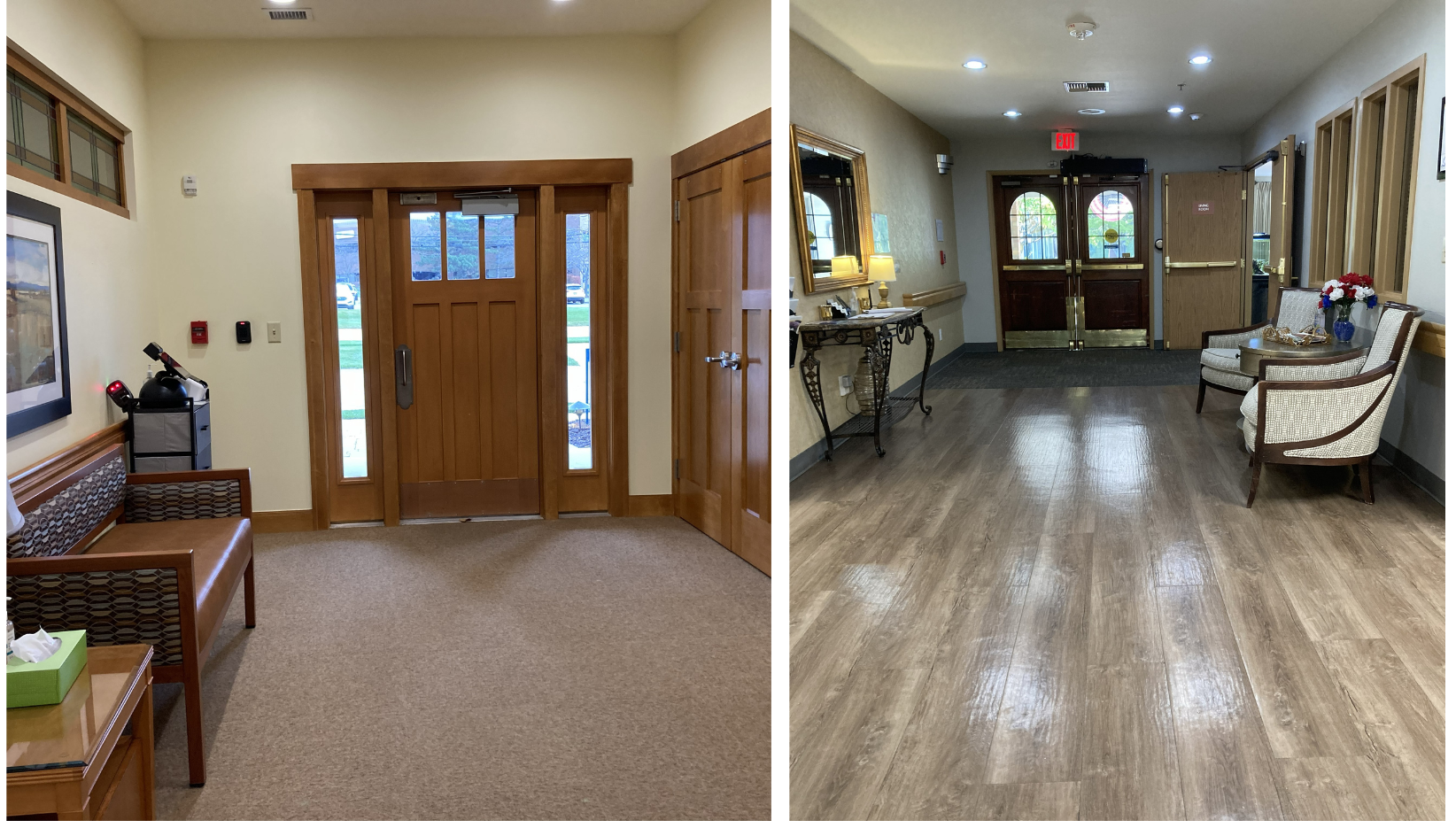
Left: Entrance with carpet and minimal glare. Right: Entrance with hard flooring and visible glare. Image by author.
Can flooring influence whether people feel comfortable leaving their rooms, joining conversations, or lingering in shared spaces? In senior living environments, carpet is often overlooked, yet it quietly shapes how spaces sound, feel, and are navigated. When chosen thoughtfully, carpeting can support communication, confidence in movement, and a sense of comfort that makes social interaction easier. Over time, those small environmental cues can shape whether people engage or withdraw.
Below, I outline how carpeting can support people in senior living environments and what to consider when choosing it.
1. Carpeting supports communication and connection by reducing background noise
Carpet absorbs sound rather than amplifying it, as hard surfaces like flooring often do. For residents who rely on hearing aids, spaces where sound echoes and builds up can make conversation difficult and frustrating. When background noise competes with voices, people may disengage, contributing to isolation, loneliness, and depression. Carpeting helps reduce background noise from footsteps, appliances, and everyday activity, making conversation and other meaningful sounds easier to hear and follow.
Quieter environments are especially supportive for people living with dementia, where excessive noise can contribute to distress and sensory overload. They also benefit staff. Lower noise levels reduce stress, improve communication with residents, and make it easier to notice subtle changes in the environment that may require attention.
2. Carpeting supports confident movement by reducing glare and visual strain
Carpet absorbs light rather than reflecting it, minimizing the glare that is often seen on hard flooring surfaces from overhead lighting and bright windows. Glare, harsh reflections, and strong shadows can make floors harder to read and more visually tiring over time, especially for older adults with age-related vision changes such as reduced contrast sensitivity.
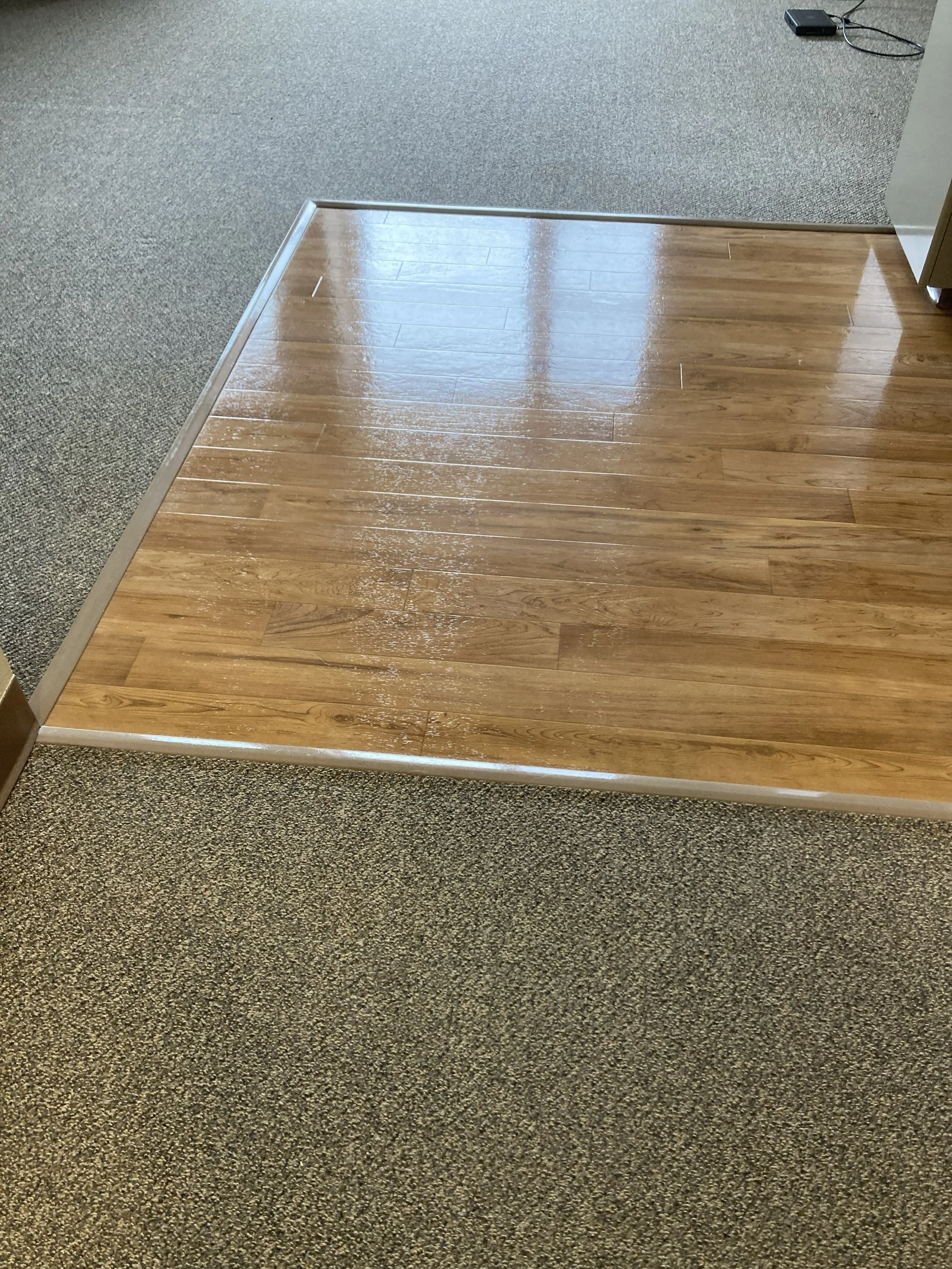
This image shows a transition between carpet and hard flooring with a raised rubber strip. The height change creates a physical trip hazard. Glare on the hard flooring makes the transition harder to see clearly, while the adjacent carpet remains glare free, highlighting how different flooring materials reflect light. Image by author.
When colors and patterns are chosen carefully, carpeting can make flooring easier to visually interpret. Clearer visual information underfoot supports more confident walking and reduces visual misinterpretation, which can contribute to a lower risk of falls. Greater confidence in movement can also make residents more comfortable leaving their rooms and spending time in shared spaces, supporting social interaction.
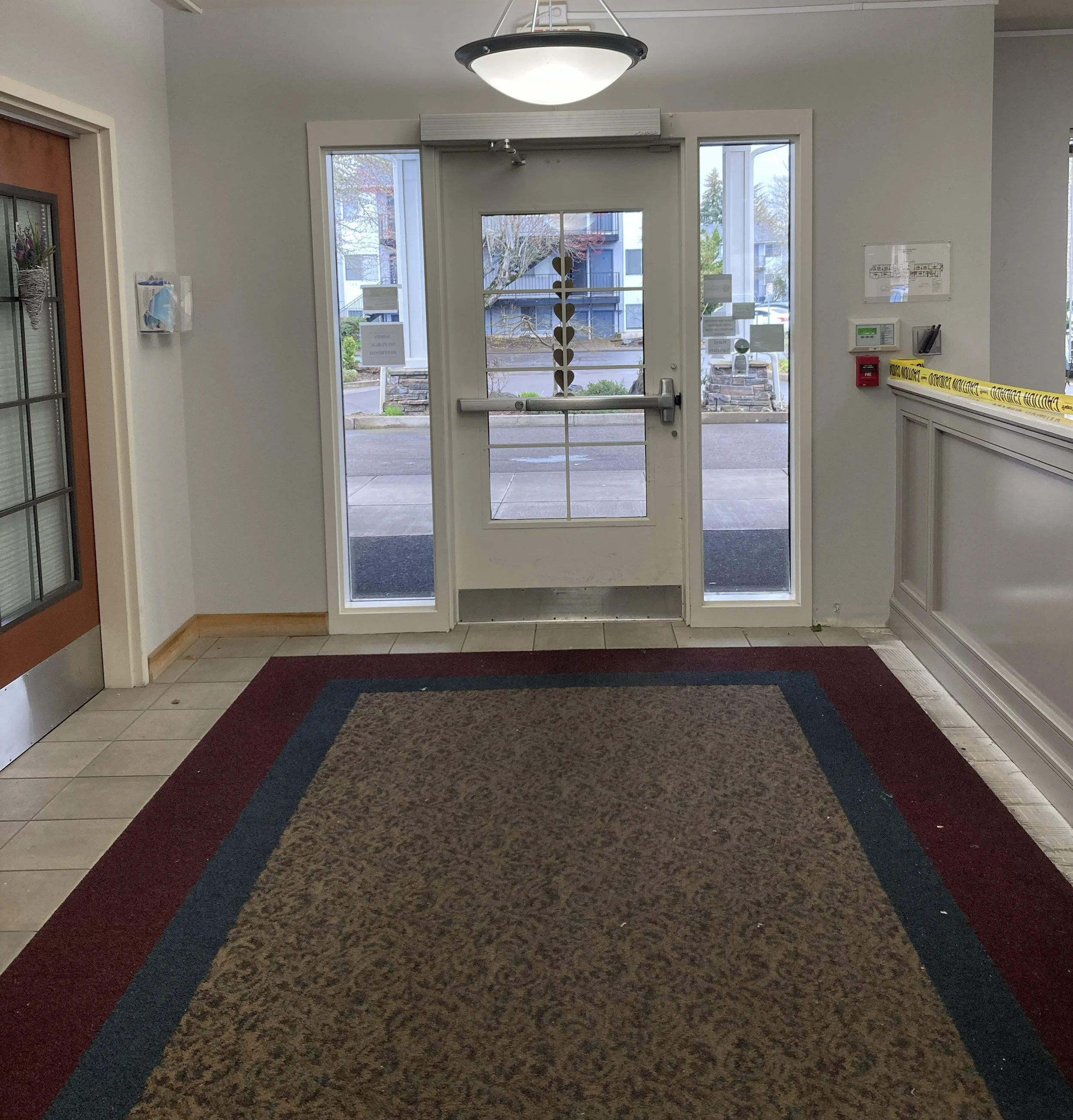
This image shows a carpeted entry surrounded by a narrow strip of tile. Although contrast between materials can be useful, this small tile perimeter creates an unnecessary transition. The high-contrast carpet border can also be misread as steps or level changes, adding visual confusion at the entry. Image by author.
3. Carpeting reduces physical strain through added cushioning
Carpet can help moderate impact when a fall occurs, which may reduce the severity of injury compared to rigid hard flooring. While carpet does not prevent falls, its ability to provide a small amount of cushioning can make a meaningful difference in environments where falls are a frequent concern.
That same cushioning can also reduce physical strain during daily movement. Carpet is more forgiving for staff who spend long periods on their feet and for residents who pace or stand frequently.
The amount of cushioning is important, however. Carpet that is too soft or unstable can make walking more difficult. The goal is a firm, supportive surface with a modest amount of cushioning. The “how to choose carpeting” section below outlines what to look for in more detail.
4. Supports dignity by creating a more homelike environment
Carpet immediately changes how a space feels. It softens scale, reduces visual hardness, and makes rooms feel more like homes than institutions.
This supports comfort, dignity, and a sense of ease that hard flooring often struggles to provide.
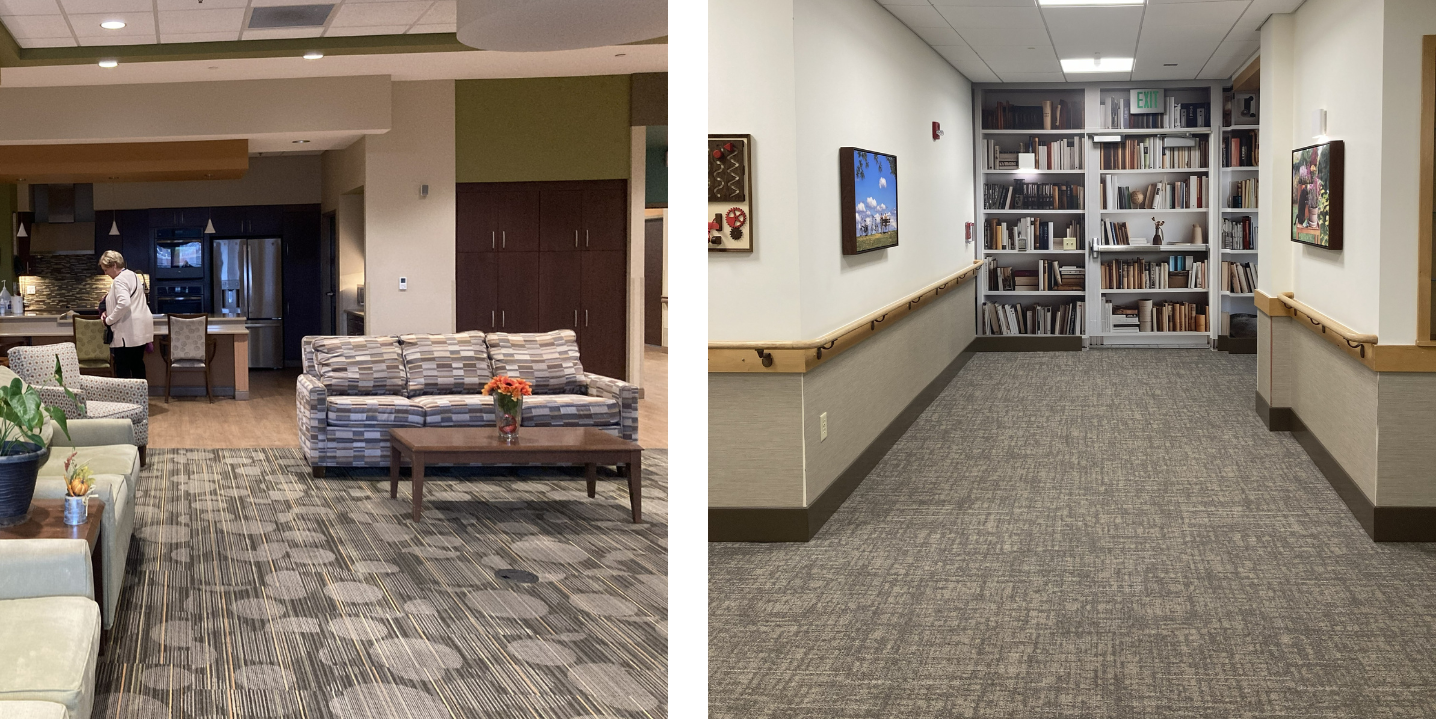
Side by side comparison of two carpeted senior living spaces. On the left, a busier, higher contrast carpet pattern. On the right, a low contrast, non directional carpet creates a calmer, more visually predictable walking surface. The comparison highlights how carpet pattern choice can influence how easily the floor plane is read and navigated. Image by author.
How to choose carpet wisely in senior living
Thoughtful carpet selection is less about style and more about how the surface supports everyday movement, perception, and long term use. The goal is a floor that feels predictable, readable, and stable over time.
1. Choose carpet that supports steady movement
Low, tight loop pile, not plush
Easier to walk on and easier to navigate with walkers, wheelchairs, and rolling carts.Dense and firm construction
Avoid carpet that feels soft or spongy underfoot, which can feel unstable and increase effort.Modest cushioning, not excessive softness
Cushioning should be subtle and controlled. Too much softness can interfere with balance.
2. Prioritize long-term stability
Carpet tiles rather than rolled carpet
Rolled carpet can stretch or buckle over time, creating trip hazards. Tiles are more dimensionally stable and easier to repair.Secure, full adhesion installation
Any movement, rippling, or edge lift undermines confidence and safety.
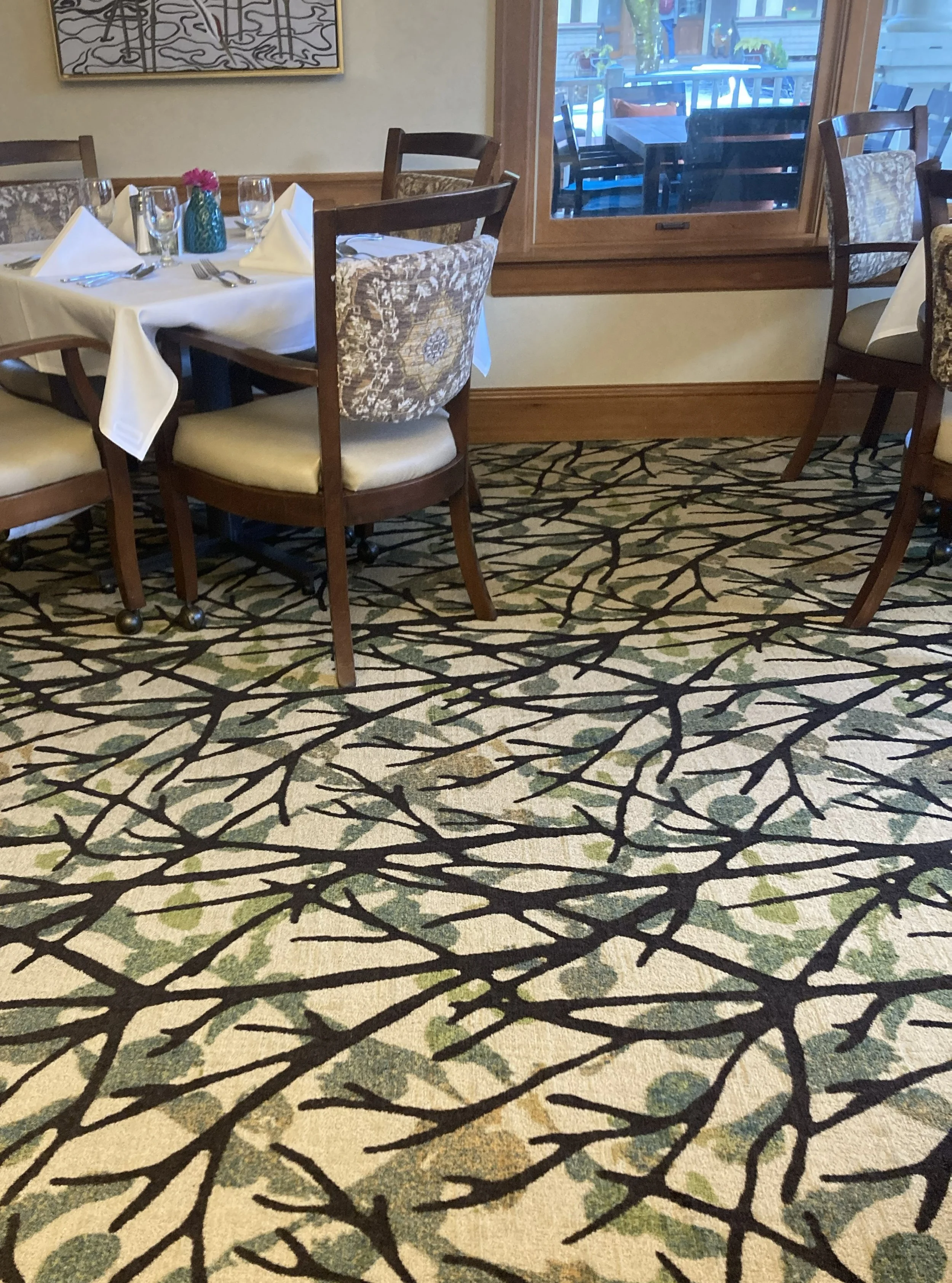
This image illustrates two common concerns: 1. rolled carpet can buckle over time, creating uneven surfaces. 2. high-contrast, irregular patterns can make the floor plane harder to visually interpret, especially for older adults. Image by author.
3. Design for visual clarity, not decoration
Large scale, low complexity patterns
Easier to visually interpret and less distracting.Avoid busy, mottled, or high frequency designs
These can be visually disturbing and confusing, especially with age-related vision changes.Avoid high contrast patterns that suggest depth or level change
Patterns should not resemble holes, steps, edges, or shadows.Use contrast intentionally at real transitions only
Contrast is most helpful when it signals a true change, giving people time to adjust their gait and reducing fall risk.Minimize changes in height at transitions
Transitions between flooring materials should be flush whenever possible. Even small changes in height can create a trip hazard, particularly for people with reduced vision, balance changes, or mobility aids. As a general rule, transitions should be level or no more than 1/8 inch in height. Where a change is unavoidable, it should be clearly visible, gently sloped, and securely installed.
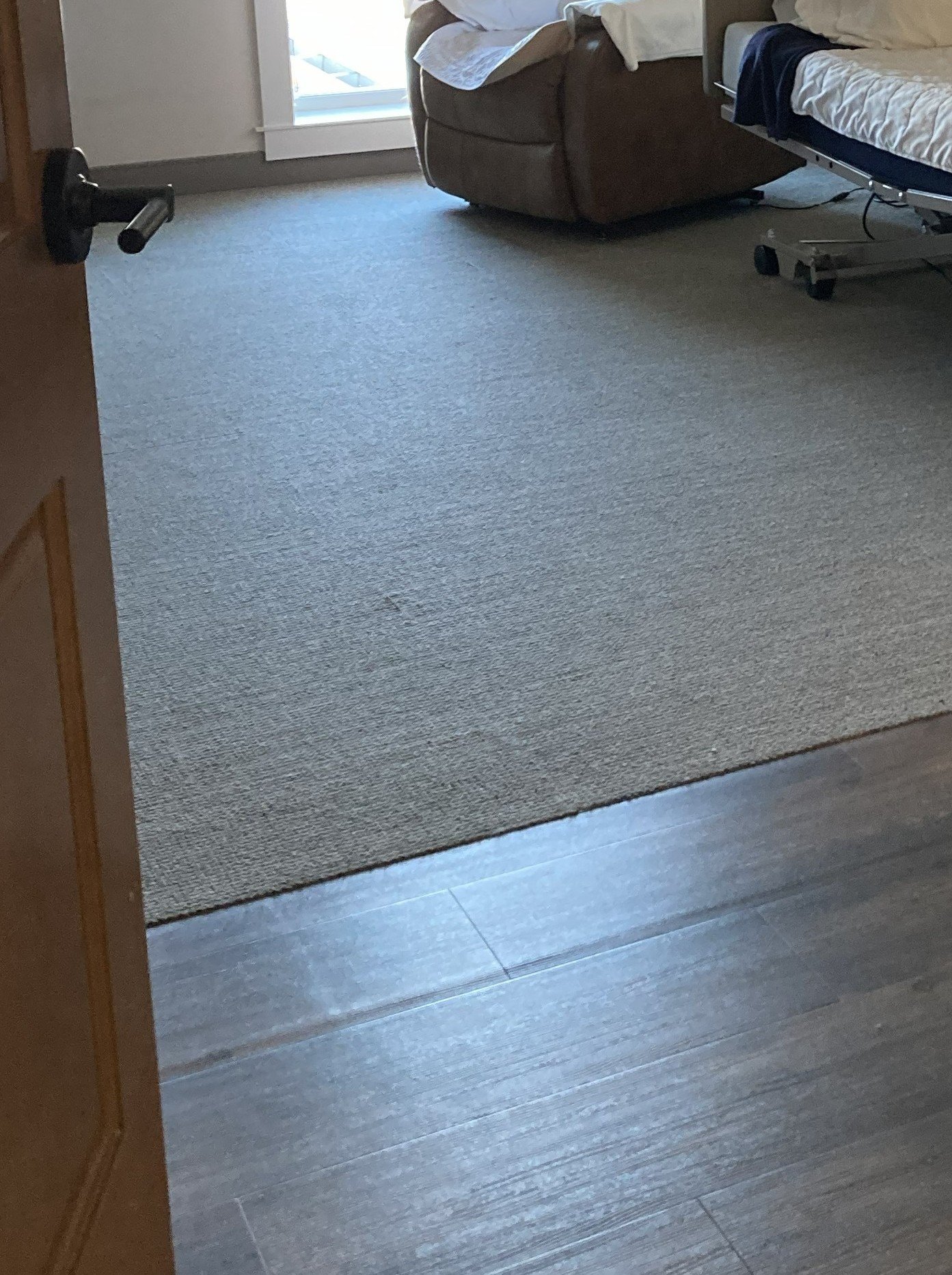
This image shows a low-profile transition between carpet and hard flooring. The color contrast helps signal a change in surface. Note the glare visible on the hard flooring, despite its matte finish. This illustrates how carpeting can help reduce glare at the walking surface. Image by author.
Carpet tiles can help support safer transitions. Because tiles are fully adhered and dimensionally stable, they are less likely to curl or lift at the edges and often do not require raised transition strips simply to hold the carpet in place. This makes it easier to achieve flush, low-profile transitions between flooring materials.
4. Plan for maintenance from the start
Carpet tiles allow localized replacement and easier cleaning
Damaged or soiled areas can be addressed without disrupting entire spaces.Maintenance and installation quality matter as much as material choice
Poor installation or deferred maintenance can turn any flooring into a hazard.
A note on impact-reducing underlayments
In some senior living environments, carpet is paired with impact-reducing underlayments designed to help moderate injury severity when falls occur. These systems aim to balance stability underfoot with modest cushioning, rather than relying on thick or plush carpet alone. Products such as Viconic Health are one example of this approach and are typically considered in areas where falls are a frequent concern.
Where carpet does not belong
Carpet is not appropriate in bathrooms, kitchens, food service areas, or other wet or spill-prone spaces. These areas require flooring designed to safely manage moisture and frequent cleaning.
Sources
Centers for Disease Control and Prevention.
Falls Data and Statistics.
https://www.cdc.gov/falls/data-research/
Valipoor, Shabboo, Debajyoti Pati, Mahshad Kazem-Zadeh, Sahar Mihandoust, and Soheyla Mohammadigorji. 2020. “Falls in Older Adults: A Systematic Review of Literature on Interior-Scale Elements of the Built Environment.” Journal of Aging and Environment 34(4):351–74. doi:10.1080/02763893.2019.1683672.
Kim, Hyung Nam, and Thurmon E. Lockhart. 2020. “Fall Risk in Older Adults Transitioning between Different Flooring Materials.” Sci 2(2):25. doi:10.3390/sci2020025.
Mehta, J., et al. (2022).
Visual risk factors for falls in older adults: A case-control study.
BMC Geriatrics, 22, Article 784.
https://doi.org/10.1186/s12877-022-02784-3
Marks, Ray. 2014. “Falls Among the Elderly and Vision: A Narrative Review.” Open Medicine Journal 1(1):54–65. doi:10.2174/1874220301401010054.
Jaglarz, Anna. 2024. “Color as a Key Factor in Creating Sustainable Living Spaces for Seniors.” Sustainability 16(23):10251. doi:10.3390/su162310251.
Valipoor, Shabboo, Debajyoti Pati, Mahshad Kazem-Zadeh, Sahar Mihandoust, and Soheyla Mohammadigorji. 2020. “Falls in Older Adults: A Systematic Review of Literature on Interior-Scale Elements of the Built Environment.” Journal of Aging and Environment 34(4):351–74. doi:10.1080/02763893.2019.1683672.
