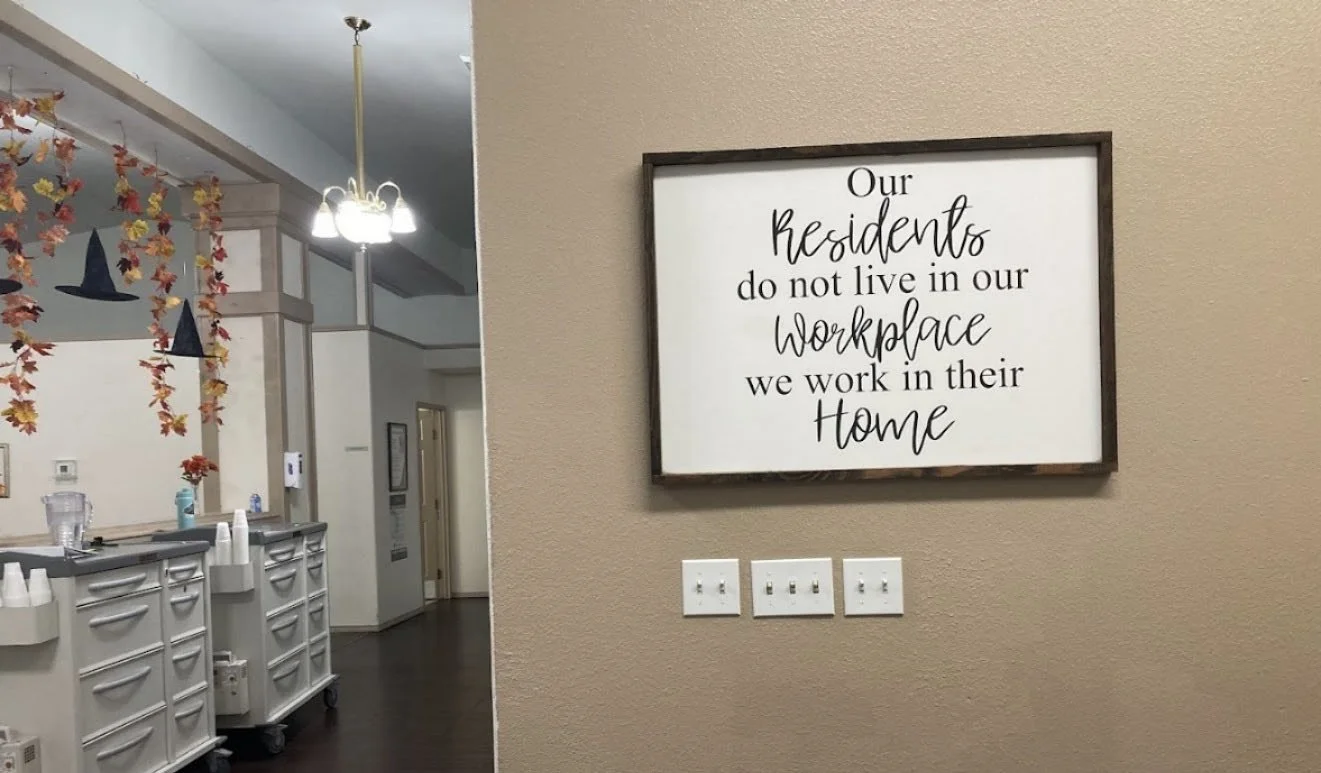
A sign on the wall reads, “Our residents do not live in our workplace, we work in their home.” The words are true and well-intentioned. Yet the very need for a reminder like this should raise concern. If caregivers must be prompted by a sign to remember that they are in someone’s home, then something deeper is off in both the environment and the culture of the community.
In many long-term care settings, the physical environment still signals “institution” more than “home.” Long corridors, blind corners, uniform finishes, and equipment that dominates common areas reinforce the feeling of a workplace. Residents may technically live there, but the cues surrounding both staff and residents communicate that efficiency, control, and tasks are the priority. Caregivers can end up feeling like workers on an assembly line, while residents may feel like products moving through it.
Culture is built in many ways, and environment plays a central role. When caregivers walk into a space that truly looks, feels, and functions like a home, the design itself shapes their behavior. They do not need a written prompt to remind them, because everything around them already communicates that reality. The kitchen is a real kitchen, not a service area. The living room feels like a living room, not a waiting room. The dining space invites conversation, not surveillance.
In a small sample of long-term care communities that I studied, staff shared how the environment influenced their work and their relationships with residents. Across the board, staff appreciated common spaces where they could spend time with residents, and when those spaces were missing, they longed for them. At the same time, they consistently disliked long corridors and having to navigate multiple levels, which they felt created obstacles to care and added to their exhaustion.
To help assess these environments, I used the Environmental Audit Screening Evaluation (EASE) tool, which measures how well a building supports resident autonomy, engagement, and staff well-being. EASE highlights the importance of features such as corridor length, clear sightlines, and especially the presence of a household triad of kitchen, living room, and dining room that functions as the social and practical heart of daily life. Staff comments often reinforced the value of these features, whether they praised having them or described the challenges created by their absence.
The findings did not always line up in predictable ways. In one community, open shared areas existed alongside long hallways, acoustic challenges, and two floors to navigate. Staff there reported higher scores for person-centered care practices but lower scores for connection with residents. In another community with strong cultural affiliation, staff reported high satisfaction and connection even though the environment itself scored lower on EASE. These examples suggest that environment, culture, and operations interact in ways that cannot be separated, and that each may weigh differently in staff experiences.
The survey also showed how demanding the work can be. More than half of staff reported being physically and cognitively exhausted by the end of their shift. Most intended to stay in their role over the coming year, yet many had also considered leaving in the past six months. Caregivers emphasized their commitment to providing relational, resident-directed care, but they also described how low staffing levels and environmental barriers made this difficult.
One particular finding came from the community using a universal caregiver model. This approach was intended to strengthen relationships by giving staff responsibility for multiple aspects of daily life, yet caregivers in that setting expressed the highest sense of connection alongside some of the lowest scores for satisfaction, workplace culture, and intent to stay. For them, the expanded role felt overwhelming. This shows how environment, care models, and staffing culture must align in order to truly support the workforce.
What stood out in my small study is that staff recognized how design details such as corridor length, sightlines, and the presence of shared household spaces shaped both their work and their relationships. These details did not always align neatly with measures of connection or satisfaction, but they reinforced how environment and culture interact in complex ways. When design supports everyday connection and ease, the message of home comes through more naturally.
What design details have you seen that make a long-term care community feel more like a home than an institution?
